Diesel Engine Conversion to Frying Oil - Page 2
 

Diesel Engine Conversion to Frying Oil

Started by Further-ing88, November 04, 2015, 05:05:03 AM

Previous topic - Next topic

jackhanow

don't panic, just fix it before.... 1966 mc5, 1986 102a2

Oonrahnjay

Quote from: jackhanow on November 05, 2015, 01:42:42 PMi believed they changed the in 2000 

     They changed to the "bad" one?  Thanks for the info (even if it is bad news).
Bruce H; Wallace (near Wilmington) NC
1976 Daimler (British) Double-Decker Bus; 34' long

(New Email -- brucebearnc@ (theGoogle gmail place) .com)

jackhanow

You can look and see which one it is. the pump is on the right side under the intake manifold right behind the timing cover, if it has the injector lines in a row on top its probably good. looks just like a 97 5.9 cummins only bigger. They have pics on yahoo.
don't panic, just fix it before.... 1966 mc5, 1986 102a2

bigred

The ISB came on the seen around 2000 I think.May have been 1999.This is when they started upping the HP.You can find these in 300,325 and 350 hp but it is still the 8.3.I'm thinking that any thing from 1999/1998 back would have the old Timex engine .
Rhet Raby           137 Elk Mtn Rd       Asheville N c 28804             1993 Prevost XL

Tony LEE

 The only thing is if you do go for the WVO conversion, you have to be prepared to go the extra mile to customise the paint job.


Been down to central America and back and still going strong

Iceni John

Wonderful!   If I had as bus like that (heaven forbid), I would beg/steal/borrow/make an FMCA oval plate and an RVIA plate for it, just to watch the faces of people when they see them.   A friend of mine had a truly despicable 1970s full-size Chevrolet that was more rust than paint, and he put an Alamo Rental Car sticker on it that mightily confused people, especially those who worked for Alamo.

Even the extra cooling is, er, "interesting".

John
1990 Crown 2R-40N-552 (the Super II):  6V92TAC / DDEC II / Jake,  HT740.     Hecho en Chino.
2kW of tiltable solar.
Behind the Orange Curtain, SoCal.

bigred

Tony:Have you ever been to Asheville N C ?There was a buss that looked like this one hanging out up here a few years back.Don't remember that much about it but I do remember the VW bus up top.
Rhet Raby           137 Elk Mtn Rd       Asheville N c 28804             1993 Prevost XL

TomC

Tom & Donna Christman. 1985 Kenworth 40ft Super C with garage. '77 AMGeneral 10240B; 8V-71TATAIC V730.

Darkspeed

What horrible things would properly cleaned and de watered fry oil do to a mechanical 6v92?


;D http://www.thebiggreenbus.org/history/  ;D

4106 6V92TA MUI + V730 8" Lowered Floor & Polished > http://www.busconversions.com/bbs/index.php?topic=24673.0 QuietBox > http://www.busconversions.com/bbs/index.php?topic=29946.0
It's all math and metal...

Gary Hatt - Publisher BCM

The other problem with burning used Vegetable oil, especially if it was used for frying fish or any frying oil for that matter in a bus engine is that you will have bears chasing you into the campgrounds and licking the back of your bus so you may have problems backing into your slip.  Sometimes the bears go away after they clean the entire back of your bus but when you fire up your engine again when you get ready to leave they come back again.  Then when you are pulling out, you have to pick up speed once you hit the pavement to pull away from them chasing you down the street.  Bears can run pretty fast for short distances.  If you do decide to go this route, I suggest you upgrade to a 500 HP engine so you can pull away faster.  If you only have a 6V71, they may be able to follow you to the next campground, starting the cycle all over again.
1999 Prevost H3-45
Gary@BusConversionMagazine.com

Iceni John

Now that diesel has got so much cheaper, maybe the fast food restaurants will start frying their "food" in diesel fuel instead.   And thanks to our friends in the EPA, there won't be any more of that stinky rotten-eggs sulphur smell to your McFries  -  imagine, they could now say their "food" is not only low-sodium but also low-sulphur.   Yeah!

John   
1990 Crown 2R-40N-552 (the Super II):  6V92TAC / DDEC II / Jake,  HT740.     Hecho en Chino.
2kW of tiltable solar.
Behind the Orange Curtain, SoCal.

chessie4905

Just remember that you are still responsible for federal fuel road taxes if you are caught with significant penalties for avoiding them. If you want to save money on fuel for use of your bus, you might want to consider some other kind of hobby.


GMC h8h 649#028 (4905)
Pennsylvania-central

Tony LEE

Quote from: bigred on November 07, 2015, 02:32:29 AM
Tony:Have you ever been to Asheville N C ?There was a buss that looked like this one hanging out up here a few years back.Don't remember that much about it but I do remember the VW bus up top.

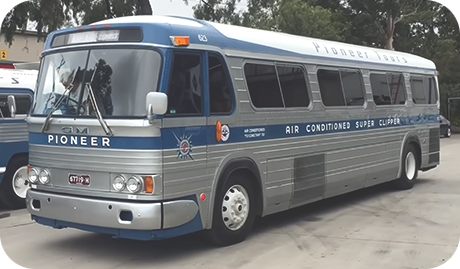
We actually saw two of these buses on the same trip in and around Colorado, both with similar second storey construction - but this one was definitely WVO powered and in the photo he is transferring fuel.

86102A3

I have run biodiesel in my F250 and I have done a lot of research on making biodiesel. During my research I have also run into many folks trying straight WVO.  The one thing that is suggested, is that over time the wax esters in in WVO can build up on exhaust valves causing long term problems. This is also why you run the low ash rate oils for detroits, to prevent build up on the valves. Because of the chemical conversion of biodiesel the wax esters are removed during the process, giving it very similar properties to petroleum diesel. Biodiesel can cause issues because it is a very great solvent. It will remove all the crud built up in lines from the petroleum diesel. When I switched to biodiesel in my truck, I changed my fuel filter several times until all the crud was cleaned out of my fuel system. This of course will also uncover leaks if you have them. Also if you have rubber fuel lines it will degrade them. So basically, the moral of this story is, as others have mentioned is that it will not really save you in the long run. If you would like to be green, I would suggest biodiesel that is manufactured to the astm standard.

brianzero

If I might make a suggestion to you, it would be to test the WVO rig on a smaller vehicle such as an 80's Mercedes, something that if it breaks down on busy city streets from WVO difficulties that would be easy to fix in a parking lot. You do get bad batches of oil with some nasty kitchen contaminants, and you do breakdown as a consequence. You need to purge the system of the bad stuff and fill with something that works. I cant imagine having to do this on a bus. What a nightmare.

I had a test rig which was a daily driver that I drove for 10 years with a straight WVO non-hydrogenated / 10% regular unleaded gas mixture with 3 micron filtration. Yes, I simply mixed the WVO with regular gas, with no conversions or heaters of any kind. I ran this for 10 years with no issues, except for that my intake valves and intake manifold were amazingly clean. The pistons crowns looked the same.