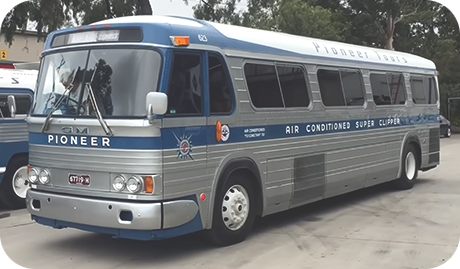
How much of a GM 5108's strength is from the shell?
 

How much of a GM 5108's strength is from the shell?

Started by HighTechRedneck, April 03, 2010, 09:35:05 AM

Previous topic - Next topic

HighTechRedneck

What happens when you remove the shell and the structural strength it proivdes?

The first photo is an GM 5108 "Old Look"  for reference.

The second is a photo of a GM 5108 that is being scrapped right now.  Everything above the floor has been removed.

(I corrected the original error of thinking that chassis had been an MC-5.)

rgrauto

That does not look like a mc5, Where is the bays?  thank's Glen

HighTechRedneck

I stand corrected, the MC-5 was the last bus they scrapped.  This is another one.  This one was a GM 5108 "Old Look" transit.

zubzub

we can't really know, but is it possible it bent that much without being loaded?

DaveG


jackhartjr

ZubZub, my guess is that yes it did!  No support!
Jack
Jack Hart, CDS
1956 GMC PD-4501 #945 (The Mighty SCENICRUISER!)
8V71 Detroit
4 speed Spicer Trannsmission
Hickory, NC, (Where a call to God is a local call!)

HighTechRedneck

Correct, it didn't sag until the bus shell was cut away.  This is because it is a monocoque design.  There are no front to back frame rails underneath.  The bus body is structured to provide the strength.

In that particular bus, there are frame members coming forward about 6 feet from the rear axle section.  Very much like on my RTS.  But forward of that, there are no large frame rails at all.  I took a bunch of photos this evening that show this.  I will post them soon.

I also photographed an MC-9 that is next up on the chopping block and has had many panels and pieces removed already.  It is easy to see that same monocoque design principle there.  Even more so in that there aren't even the frame members coming forward from the rear axle section typical in the GM designs.  The load is transferred to the body immediately instead of over the span of several feet.

Dave, this is one more reason to come see the world headquarters of BCM. ;D  This is at the Choo Choo Express Garage.  Scrap metal prices are coming back up and they are getting back to scrapping buses.  It is amazing (and saddening to a bus lover) how fast they can tear them down.

mikewarmblood

I hate to see buses scrapped.  God I can only hope metal prices plummet or all used buses are in trouble.  It breaks my heart to see that.  Old looks are getting realy rare.  I hope to find one someday.  Mike.

artvonne

  Thats what GMC's do when you skin em out. In that picture, there isnt anything holding it together other than some angle iron running lengthwise, and the wood floor.

mikewarmblood

Are there any  other bus companies that does that besides GMCs?  I know that most buses use tubular frame or spaceframe through the walls and roof.  If you take the skin off them they still hold together. I thought all buses were like that except schoolbuses then I am finding out that fishbowls and GMCs of that era  uses the skin and wood floor as structure.  I am now worried about my Flxible.  Although under the Flxible there is much more frames and structures than a fishbowl.  On a Flxible Newlook is the floor just what it is a floor??  There are a lot of framing going across the bus every three feet and there is a bunch of tubes in the front and lots of angle iron and tubes and plates in the last 15 feet of the bus? are there any Flxible experts on here? that can explain it better than I understand it? and is the Flxible tubular framed?  I thought the fishbowls were tubular as well but guess not.  Thanks Mike.

artvonne

  Its really nothing to worry about. The skin is heavier, like 1/8th inch with ribs, its pretty strong stuff. The curved roof adds even more strength to the structure. The bubble shape end caps are steel, and incredibly strong. On an OTR coach like a 4104, 06, 07, 05, 08, etc., the cargo bay floor being tied to the bulkheads, and the catwalk running under the center isle, add even more structural rigidity to the structure. You need to examine how aluminum aircraft are constructed. GMC's are simular, but much, much heavier and stronger. They wouldnt still be around after 70 years if they wernt strong.

mikewarmblood

Oh I have no doubt that a GM is agreat design.  I am just comparing a GM to a Flxible.  The Flx is like a Ford compaired to a Chevy when we talk buses. Fords have somethings that are much better than compared to Chevys  and vice versa.   I look under my Flx and looks like a lot of framing compared to the Fishbowl.  So I am wondering if the Flx has a skeleton unlike a Fishbowl.   I think the engineering was really a marvel with GMC very precise.  Whereas the Flx just looks so much heavier than the GMC cause they couldn't engineer something that light and as strong as a fishbowl and the looks are the best  I think the fishbowl is the most beautiful transit bus ever built.  Thanks Mike

RJ

Mike -

What's the story on that 4106 parked in the background of the sidewall-less Old Look?

;)
1992 Prevost XL Vantaré Conversion M1001907 8V92T/HT-755 (DDEC/ATEC)
2003 VW Jetta TDI Sportwagon "Towed"
Cheney WA (when home)

pvcces

mikewarmblood, all the Flxibles that I've looked at were lighter than the GMs. The axles were a dead giveaway; the Flex axles are much smaller.

Have you seen some that were heavier?

Tom Caffrey
Tom Caffrey PD4106-2576
Suncatcher
Ketchikan, Alaska

happycamperbrat

Very dramatic photos Mike! If you come across an RTS that your scrapping, try to get a photo with just the side of the 3rd member cut out  ;)
The Little GTO is a 102" wide and 40' long 1983 GMC RTS II and my name is Teresa in case I forgot to sign my post