Detroit Diesel 2 stroke- 92 series vs 71 series - Page 4
 

Detroit Diesel 2 stroke- 92 series vs 71 series

Started by Dreadnought, June 24, 2017, 07:59:22 AM

Previous topic - Next topic

Iceni John

Quote from: kyle4501 on June 29, 2017, 06:31:03 AM
Too fast thru the radiator doesn't make sense to me - isn't it is going the same speed thru the engine?

What makes more sense to me is lower pressure at the pump inlet causing tiny 'air' bubbles to form in the coolant - that reduces the coolants ability to transfer heat. . . . . It takes a lot longer for that 'air' to go away than it did to form.
Changing a properly designed system seems to always present unexpected opportunities.  :o


BTW, I have a technical paper on my coach that states the cooling system was designed for the coolant temperature to stabilize at 125F above ambient at full power. Would be great if they all came with that information.

It's too bad that Arrowhead Radiator's website is now gone  -  they had a very informative paper there called "14 ways to improve cooling in high-performance vehicles" or something like that, and it explained very clearly about the pros and cons of different coolant flow rates.

You mention bubbles caused by suction.   That's cavitation, and it's something I am concerned about if I start to change coolant flow rates and pressures by having a second radiator.   Whether I would need an extra circulation pump like Geoff has for his second radiator, or if the engine's water pump has sufficient pressure and flow rate (bearing in mind what Clifford said about wear on impellers), are all things I need to research before plunging into this project.   I just don't want to create more problems than I solve.

John
1990 Crown 2R-40N-552 (the Super II):  6V92TAC / DDEC II / Jake,  HT740.     Hecho en Chino.
2kW of tiltable solar.
Behind the Orange Curtain, SoCal.

kyle4501

I worked with Griffin Radiators on hard to cool cars & trucks that had been modified for more power in the early 90's.
I was surprised to see how much was involved in a cooling system.

They were very quick to find real & durable solutions for those unusual cooling applications.
(sure was nice to have the quickest street car at the drag strip that didn't have any cooling problems - even in August ! )

I asked their thoughts on too fast thru the radiator. Their response was that cavitation always happened before they could find a flow that was too fast.


Life is all about finding people who are your kind of crazy

Get your facts first, then you can distort them as you please (Mark Twain)

Education costs money.  But then so does ignorance. (Sir Claus Moser)

Dreadnought

Quote from: kyle4501 on June 29, 2017, 08:46:34 PM
I worked with Griffin Radiators on hard to cool cars & trucks that had been modified for more power in the early 90's.
I was surprised to see how much was involved in a cooling system.

They were very quick to find real & durable solutions for those unusual cooling applications.
(sure was nice to have the quickest street car at the drag strip that didn't have any cooling problems - even in August ! )

I asked their thoughts on too fast thru the radiator. Their response was that cavitation always happened before they could find a flow that was too fast.


I talked to griffin too.

I mention it here

http://www.busconversions.com/bbs/index.php?topic=31978.0

It was interesting, they said that although copper was a better conductor, the way the copper or even brass was soldiered didn't help heat condiuction and aluminium didn't have those impediments. They said they did custom work not only for hot rods but also industrial applications, where they would use CFD (computation fluid dynamics) to model the system etc.

One of the truck applications I worked on- the pump would cavitate if spun any faster and the impeller would eventually suffer from cavitation erosion. The solution was to decrease the pump rotational speed but make it bigger to maintain/increase volume flow rate
Live Fast, Live Well, Live Free

1964 MCI MC5 8v71

TomC

I have a '63 Ford Falcon with 302 in it. I replaced the water pump with a rebuilt. The impeller looked like a piece of heavy sheet metal with 6 bent lips on it. It cavitated badly above 3,000 (car is geared 3,500 at 75), and wouldn't cool. I then replaced with a Ford rebuilt that had the normal look impeller and problem solved.
Tom & Donna Christman. 1985 Kenworth 40ft Super C with garage. '77 AMGeneral 10240B; 8V-71TATAIC V730.

luvrbus

Quote from: luvrbus on June 27, 2017, 03:53:12 PM
Here is some food for thought,the water pump on a Detroit is 67 GPM @2100 rpm and takes very little wear on the impeller to diminish that flow.When in marine use the raw water pump is 107 GPM over the the exchanger on a 6v92 with 70 degree water    

How did this happen lol
Life is short drink the good wine first

busfan

With all the battery power why not a large radiator fan?


busman

I know this an old topic but it is a perennial one.
Just joined this board and I would like to add my 2 cents worth as I have taken a slightly different approach.
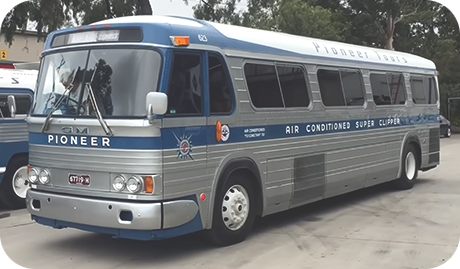
Bus was an 84 model, here in Aussie called a Tourmaster. Pretty standard setup with rear mounted north south 6V92T and a six, now 7 speed crash box. Rockwell running gear. Called Vanishing Point after a favourite movie.
Pretty rusty when I purchased, abandoned project, at that age there must have been 20K rivets, all potential leak points so a coremat 6mm fibreglass body was on the agenda, after lots of steelwork. Cut off at floor level and started again.
Very early in the piece joined an experimental Lithium group here and fitted both 12 and 24 volt Lithium banks, 200 Ah x 12 V and 800 Ah x 24 V. To charge them fitted 3000 watts of solar.
With so much electrical power thermatics should be looked at. The original radiator in good condition was rodded and tested, 4 x 14" high performance fans fitted (these had the motors from 16" fans) in a tight fitting shroud.
Knew this would not be enough so bought a ford V8 radiator and shroud/fan setup off ebay. This has 2 x 12 v fans, run real well in series with 24 v supply. Perfect for coach alone, but when I put my enclosed car trailer on, with 400 ltrs water, Suzuki 5 door Grand Vitara, washing machine, tools, coach and trailer spares, was restricted to 80 kph. I don't like to hold up traffic so back to the drawing board.
I invested in a custom made radiator (aluminium) which was thicker and higher than the ford one which was removed. We fitted 2 x 16" fans to the new radiator
This allowed travel at 100 kph on even the hottest days, on the flat with the trailer on, sat at around 82 deg C.
However to get anywhere west of where we lived at the time you had to climb the great dividing range, some of which is 1 in 10, or a less steep route which is 9 k's long. Either way engine heat was getting dangerous by the time you got to the top.
As coach by itself was solved I took the ford radiator and mounted it above the washing machine box on the trailer, rationale was I only needed it with the trailer on so it could stay there. Couple of hoses with hydraulic fittings and a spare wire via the trailer plug and the trailer mounted radiator only comes into play at 86 deg C, and then only for a couple of minutes. Water flow is controlled by a couple of electric ball valves that only open when the trailer mounted radiator is activated.
So finally I am happy with the cooling performance as I am actually able to move in excess of what the old Horton fan was doing which was 7,000 litres of air a second at full song. And I have saved the approx 10% of horsepower required to drive the fan
Funniest thing is everyone sees this black thing sitting up there and thinks the whole trailer is a bloody fridge unit !

lostagain

Busman, sounds like  a great system you built! Are your radiator fans powered only by the solar panels? If so, what do you do when the sun don't shine?

I have 700 watts of solar on my bus, which is a great help when the sun shines high and bright. But there are a lots of times when it doesn't, either because it is cloudy, or parked in the shade, or the sun is low like in winter, and I have to run the generator if not plugged in to shore.

JC
JC
Blackie AB
1977 MC5C, 6V92/HT740 (sold)
2007 Country Coach Magna, Cummins ISX (sold)

busman

Hi JC,
I have switches up front that allow me to choose where the power comes from. I can select either the DN50 or solar/battery bank just by flicking a switch. Divided into 3 sections, original, custom rad and trailer rad. Also have an LED for each section so I know if they are on or not, when they should be. This is how I know how long the trailer one runs for.
I have no generator, with so much solar and the large Lithium bank I don't need one.
If it is raining for instance, I will be down on thermatic fan use, there has been a couple of occasions going downhill in the rain when they have all been off, it depends on the conditions as to how much cooling is needed, less heat, less cooling.
The thing I have discovered is simply that you need to move around the same amount of air as the original, then thermatics work well.
Having such a large battery bank is a bonus, I can run one of my splits all night with no problems
Cheers
William