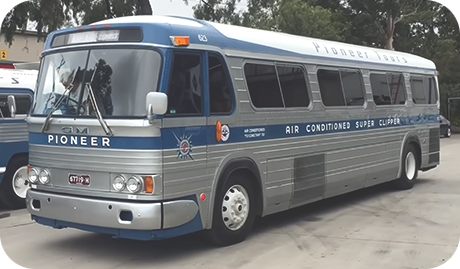
How to get it home the first time Part II -- pushing the envelope
 

How to get it home the first time Part II -- pushing the envelope

Started by BG6, March 05, 2009, 03:27:39 PM

Previous topic - Next topic

BG6

Okay, you read Part I, and want to know what your other options are.

DISCLAIMER:  Anything I say here might not work. 

There you are, floating in your plastic bag . . .

You decide that you can't afford the expense or delay of hiring someone to move your coach.  The seller just laughed when you asked about borrowing operating authority.  And there sits your coach.

The first thing to do is get the travel permits for each state you will go through.  Call or email the motor vehicle department Commercial Vehicle desk, ask the following questions, and WRITE DOWN the answers:

1)  Hi, I'm (your name).  Who am I talking to?  And where are you located?  Do you have an ID number?

2)  I've just bought an old Greyhound* bus in (State 1, where it sits).  I need to drive it to (State 2, where it's going), and I'm going to convert it into a motor home.  What permit do I need to drive it through your state?  How do I get that permit, and do I get that when I come into the state, or do I have to get it before starting out? 

3)  Will the permit from State 1 be valid in your state, if I'm just passing through?

4)  Do I need a fuel permit for a privately-owned, not-for-hire vehicle?

5)   Okay, to recap (read all of it back).  Is that correct?  Is there anything that I'm missing or need to know or do?  What is the total cost of permits, fees, etc, and where do I send the money?

* Yes, I know it may not have ever had the Running Dogs of Capitalism on the sides, but you're dealing with bureaucrats who have NO CLUE, but who have seen Greyhound Buses

Once you have that information for EACH STATE that you will pass through, figure your route.  It might be cheaper to go hundreds of miles out of the way to avoid a state which nails you on permits and fees.

With your route "boilerplated," now get a copy of the Rand McNalley map book for commercial vehicles (any truck stop will have these, and toward the end of the year they mark them WAY down).  The maps will show truck routes, weigh/inspection/tax stations, etc.  There are also lists of low overhead clearances, low-weight-rating bridges and other considerations, but generally these only cover major roads.  If your planned route looks good, then mark it in the map book and write down the turns on a separate sheet of paper (this is when it's really great to have a laptop and Street Atlas or other map program).

Again, it's better to go out of the way than risk narrow or windy roads, or those with steep grades.

Okay, at this point you should have your permits and know your route.  The next step is coach "de-milling," preparing the coach for the trip by making it look less like a commercial vehicle.

IF there are still USDOT and similar numbers and IFTA stickers, etc on the side, LEAVE THEM THERE, and ignore anything I say about changing the outer appearance.  If that is all there, and you tape the temp permit in the window, you'll pass 99 and 44/100ths percent of the traffic cops and tax collectors without a problem.

If, however, they have removed their stickers, go buy a can of cheap flat black spray paint, some masking tape and a newspaper.  You want to paint over the destination sign, and flat black shows that you have done that.  Just taking out the sign isn't good enough -- what you are trying to do is make any cop who sees you understand at a glance that you're not operating commercially. 

Next step is to make a couple of signs with FELT MARKERS, saying "PRIVATE Motor Home Conversion" or words to that effect.  Don't bother with the laser printer.  Professional transporters print their USDOT numbers and other information, but you want the traffic cop to know without reading the sign that you're not a pro.  Don't be sloppy, but don't be too worried about how the sign looks.  One sign goes right in front of you in the windshield, and the other you tape to the door.

Now unbolt the seats, all except the second row.  Leave all of the seats on the floor behind the row that you left, so if you hit the brakes, that row will keep them from moving forward.

Generally states consider a motor home to be a vehicle with bed, toilet, and cooking facilities.  Bolt a cot and a portapotty (if the washroom is gone) to the floor or wall, and put in a hotplate (with an extension cord which will reach shore power), and most states will accept that.

The combination of removing commercial seats and adding living quarters will help convince a traffic cop that you are what you say you are -- just a busnut, trying to get home with a new toy.

Ready to go?  See Part IIA


scanzel

OK I fly out to Reno NV and meet up with a friend from Phoenix Az and the seller son picks us up at the airport in Reno. Takes us to the house to look at the bus, we do an inspection and take it for a drive. Come back and seller says if I don't want it no problem your just out a flight and now need to return home.We buy it. Seller puts a temp California 3 day permit on the front windshield. We decide to take it, have lunch with the seller and he takes us to the gas station and puts in $100.00 of diesel for us. We hit the road for the east coast. The power steering pump blows on I-80 in Wyoming and we drive to Rock Springs to see a Detroit Diesel dealer, stay over night, next morning he says he is too busy to fix it, must wait a few days. We hit the road with no power steering adding a little fluid to the reservoir every fuel stop to keep pump from seizing up. We take I-80 all across the country through 11 states, 2800 miles and never get stopped with no marker plate on the back of the bus except a vanity plate advertising the tour bus company. Once at night a cop pulled up behind us and I thought for sure we had it but he followed us up the exit ramp and then split. Coming into Salt Lake city we had to pull into the weigh station but the woman just waved us through. Stopped at a small truck stop one morning and had to deal with the two pump system, go in and give girl credit card. Go out and take hose off of first pump and lay on the ground, no place to hang it up. Go to the other pump and start filling on automatic fill. Go around back of bus to check oil and here come about 25 gallons of diesel fuel my way from the other hose laying on the ground. When I put it down the latch locked on a few notches unknown to me so when I activated the other pump both were pumping. I run over a $#!% it off and continue to fill tank. So her is about 25 gallons of diesel on the ground that I just payed for. I go in and sign slip and tell attendant we need some speedy dry for the fuel spill, he says don't worry they do it all the time. I tell him a lot and he still says don't worry, so we leave behind a very slippery fuel bay area. So we left Reno on a Sunday at 4:30 pm and got back home to Connecticut on a Thursday at 4:30 pm. Had Great time driving and trying to keep ahead of the snow storms right behind us on I-80.
Steve Canzellarini
Myrtle Beach, SC
1989 Prevost XL

jok

Very informative series BG6. I wish it was available when we picked up our bus. Should be saved where it can be referenced easily by future first time buyers.

We had the same problem as scanzel at a fuel island, except we only lost about 7 gallons of fuel. Still had my heart racing. I think that at some pumps the handle does not reset itself after filling up. Now I check the nozzle before I set it on the ground.

jok
1990 Prevost
1977 MC8-Sold
Southwest Michigan

bobofthenorth

Another big thing to remember at those satellite pumps is to walk around to the main pump, shut it off and hang the hose up BEFORE you make the long walk to the fuel desk.
R.J.(Bob) Evans
Used to be 1981 Prevost 8-92, 10 spd
Currently busless (and not looking)

The last thing I would ever want to do is hurt you.
Its the last thing but its still on the list.

John316

I agree Bob! I haven't done that enough times! Just gives extra exercise.

God bless,

John
Sold - MCI 1995 DL3. DD S60 with a Allison B500.

belfert

As far as fuel goes, my Dina has fuel fillers on both sides like a semi.  The tank goes all the way across the bus with openings on each end.

At a truck island it isn't clear if using both hoses actually fills any faster.  I suspect both hoses use the same pump so the GPM is the same with one or two hoses.  Flying J has an independent pump on each side of the RV lane so I use my credit card at each pump for faster fill especially with the small nozzles.
Brian Elfert - 1995 Dina Viaggio 1000 Series 60/B500 - 75% done but usable - Minneapolis, MN

JackConrad

Quote from: belfert on March 07, 2009, 07:12:46 PM
At a truck island it isn't clear if using both hoses actually fills any faster.  I suspect both hoses use the same pump so the GPM is the same with one or two hoses. 

Delivered GPM might be affected by hose diameter. I wish I had the luxury of a fill on either side of our coach. MCI didn't think about that.  Jack
Growing Older Is Mandatory, Growing Up Is Optional
Arcadia, Florida, When we are home
http://s682.photobucket.com/albums/vv186/OBS-JC/

oldbird

You got lucky. Putting on a 3 day California permit on a bus bought in Nevada. How did he get the permit as the state you buy it in issues the permits. Counterfit?

BG6

Quote from: JackConrad on March 08, 2009, 06:41:16 AM
Quote from: belfert on March 07, 2009, 07:12:46 PM
At a truck island it isn't clear if using both hoses actually fills any faster.  I suspect both hoses use the same pump so the GPM is the same with one or two hoses. 

Delivered GPM might be affected by hose diameter. I wish I had the luxury of a fill on either side of our coach. MCI didn't think about that.  Jack

They thought about it, and decided not to do it.  They wanted the filler right there were the driver gets in and out, so that you wouldn't have one driver getting off shift to start filling and the next driver getting on shift to forget to pull the nozzle out and close the cap.  Everything that is routinely serviced without a shop call is on the right side, so that the driver can see if there's "one last thing" being done by the mechanic.