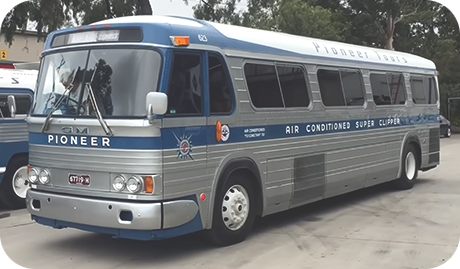
Manual vs. Power Steering in PD 4107
 

Manual vs. Power Steering in PD 4107

Started by Runcutter, September 10, 2006, 08:19:37 AM

Previous topic - Next topic

Runcutter

Made it back from the initial trip (New Hampshire to Dallas, via New Brunswick, almost 3200 miles).  No significant troubles, so the work Spike and Jim Michaud did, to make sure the coach was fully roadworthy (arranged starter rebuild, new radiator, ended up with new driveshaft to eliminate vibration), paid off.

I didn't expect to have trouble with manual steering, since she's only a 35 footer.  (Original owner, Connecticut Company didn't spring for the PS option.)  I drove plenty of 35 and 40 foot transits (old look) without PS.  Our 4905's, at 40 feet did have power steering - I couldn't imagine taking corners in downtown Boston, with that long wheelbase, without power.

Come to find out, I did notice a difference - particularly in parking lots, and in downtown Moncton NB - especially on the right turn immediately after I saw the 3-meter vertical clearance sign.  I'm sure it couldn't be that I'm not in my 20's any more.  Wasn't an issue on the highway, but Massachusetts potholes (almost lost the generator exhaust pipe) and highway bridge joints were kind of jarring on the arms.

So, what is the experience (cost) with adding power steering - if it's still possible to this 1968 coach? 

The other issue I'm having is some chattering of the clutch in first, pretty significant in reverse.  I haven't driven one of these in about 28 years, so it took a little while for my old habits to return; but there have been others driving a few miles here and there for repairs - and I don't know exactly how she was behaving when the previous owner put her on the market.  I'm hoping an adjustment will take care of it - any ideas there?   Gone are the days when my responsibility ended with writing up a defect card - now it's write the defect card, write the check .....

Arthur Gaudet  Carrollton, TX 
Arthur Gaudet    Carrollton (Dallas area) Texas 
Former owner of a 1968 PD-4107

Working in the bus industry provides us a great opportunity - to be of service to others

TomC

It might be around $2,000 to have Sheppard power steering installed, but I did it on my transit that had air assisted manual steering. It went from a loose 8 1/2 turns lock to lock to a nice tight 4 1/2 turns lock to lock with finger tip force.  Love it! As to the clutch, sounds like you have the dry clutch, once it starts chattering, not much to do except pull it out.  You can try sanding the hot spots off, but will most likely come back.  Don't think adjusting it will make much difference.  One of the niceties of having a manual.  Considered changing it to an Allison V730?  Probably won't be that much more than the clutch change, and what a difference in driving pleasure!  If you jam on the accelerator, course you'll get worse mileage, but being conservative, will get close to the same as you're getting now.  Good Luck, TomC
Tom & Donna Christman. 1985 Kenworth 40ft Super C with garage. '77 AMGeneral 10240B; 8V-71TATAIC V730.

gus

I have hyd power assist steering on my 4104 and it was sloppy when I first got it. I read the book and found out how to adjust it at the top of the steeering box. 4107 is probably the same if slop is a problem. The power assist is not as good as Sheppard on the road but it sure helps in slow speed turning.

You may have oil on the clutch. I have chattering with my 4104 and I just live with it until I can get the 6-71 rear seal replaced.

Since you are an old hand at driving I assume you know not to slip the clutch.
PD4107-152
PD4104-1274
Ash Flat, AR

Beatenbo

I owned several GMs in the past, oil on clutch?  Buffalos have wet clutch that runs in oil. 3 cluthch disc with plates inb etween. I have had chatter before worse in reverse sounds like some worn supension. It's possible for someone to change trans bell housing, clutch everythin there to dry type but not likely. Some dry may came from factory but I;ve never seen. A wet clutch system on a GM Buffalo will easily go 500 K along with the engine if propely adjusted and cared for.